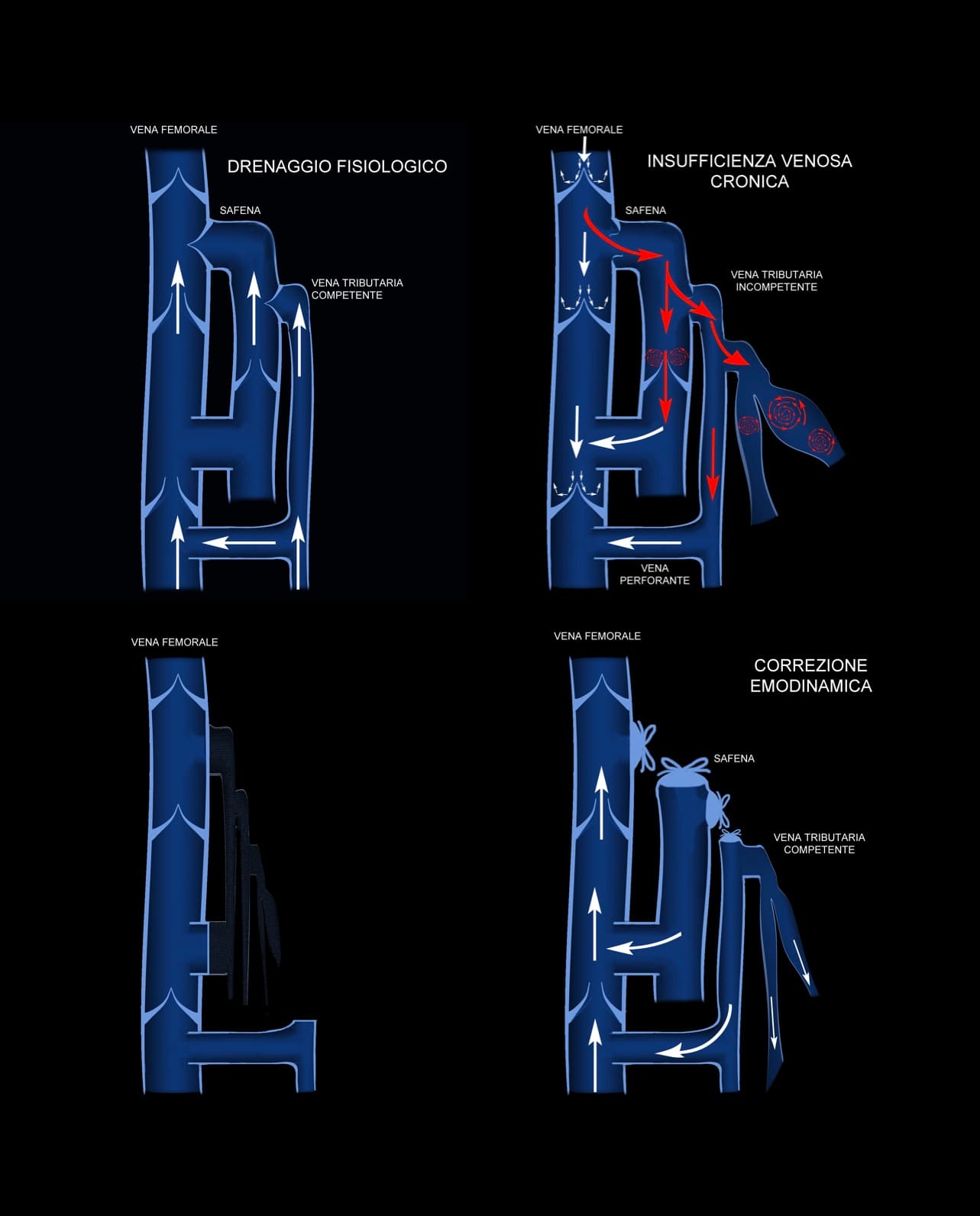
Patients with chronic venous disease (“varicose veins”) often come to the specialist clinic convinced that they have a problem with their “saphenous vein”.
In reality, the saphenous vein is neither the tortuous vessel that the patient sees on the surface of the leg, nor the direct cause of varicose veins (Does a saphenous varicose vein exist? Phlebology 1997; 12: 74–77).
The saphenous vein could be described as the “motorway” used by the superficial venous system to return blood towards the heart and lungs. It runs within an anatomical fascia, a sort of “sheath”, which protects it from developing significant dilatation and tortuosity.
The saphenous vein connects the superficial venous system (visible and palpable under the skin in the case of varicosities) with the deeper venous system. What the patient sees and feels is precisely the more superficial venous system: a network that should carry blood into the saphenous vein, from the surface towards the deep system, from the feet towards the heart.
Valves inside all these veins ensure that blood always flows in this direction (Lower limbs venous kinetics and consequent impact on drainage direction. Phlebology. 2018; 33:107-114)
When these valves become damaged at the junctions between the surface and the saphenous vein and between the saphenous vein and the deep system, reversals of venous flow occur, with consequent upward movement of blood towards the surface, dilatation of the veins visible to the naked eye, increased pressure within them and the associated onset of symptoms (Altered velocity gradient in lower limb chronic venous disease. Phlebology. 2019 Feb;34(1):17-24).
At that point the saphenous vein may show venous reflux within it, where “reflux” means the reversal of the direction of blood drainage: no longer from the surface to the deep system but from the deep system to the surface, no longer from below upwards but from above downwards.
Finding reflux in the saphenous vein does not mean that it is “diseased”: it simply indicates that it lies between two points of the circulation at different pressures. It is rather like a draught in a room of our home caused by a window and a door being open at the same time. To eliminate the draught it is enough to close the door or the window, thus allowing the air to circulate normally again.
During the ultrasound examination, a specialist with specific expertise can and must perform so-called “reflux elimination manoeuvres” designed to identify precisely the points affected by disease.
All too often, the ultrasound examination is focused on the presence or absence of reflux along the saphenous axis. Attention must instead also, and above all, be directed at identifying the source of that reflux, as well as the point where the reflux ends. Only in this way will it be possible to indicate a treatment tailored to the specific needs of each individual patient. Only in this way will it be possible to propose a treatment aimed at repairing a diseased vein rather than removing it, achieving a result shown to be twice as good in terms of disease recurrence, even at 10 years of follow-up (Varicose vein stripping vs haemodynamic correction (CHIVA): a long term randomised trial. Eur J Vasc Endovasc Surg 2008;35:230-7).
A detailed description of the possible therapeutic solutions involving saphenous vein preservation and repair rather than removal of the diseased vessel is provided on the dedicated web page at this link.